

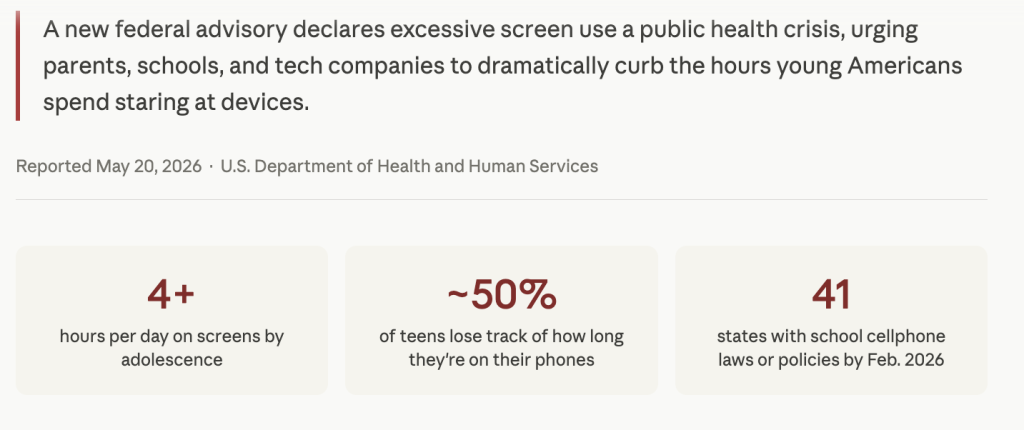
The U.S. government issued one of its most forceful public health warnings in years on Wednesday, declaring that excessive and harmful screen use among children and teenagers has become a national crisis — one that threatens sleep, mental health, academic performance, and physical wellbeing.
The 43-page advisory, released by the U.S. Department of Health and Human Services in the absence of a confirmed surgeon general, concludes that screen exposure often begins before a child’s first birthday and accelerates sharply through adolescence. By the teenage years, the report warns, many children spend more hours in front of screens each day than they do sleeping or sitting in school.
While screen use can have some benefits, the evidence of a range of risks to children's overall mental and physical health is mounting."
— HHS Secretary Robert F. Kennedy Jr., from the advisory’s opening pages
The report links excessive screen use to a cluster of serious health outcomes: worsened sleep, declining academic performance, reduced physical activity, heightened anxiety and depression, lower self-esteem, and in some cases, drug use. Social media scrolling, constant texting, and hours of gaming were all flagged as contributors to what officials called a pattern of harmful digital consumption.
Kennedy and HHS officials were careful to frame the problem broadly — not as a social media issue alone, but as encompassing the entire digital ecosystem: smartphones, tablets, chatbots, gaming platforms, and online gambling apps.
Recommended limits
- No screens for children under 18 months
- Less than one hour per day for children under 6
- Up to two hours per day for children ages 6 to 18
- All other activities — homework, sports, meals — completed before screen use begins
Calls to action — who must act
The advisory issued targeted recommendations across five groups:

- Youth: Track screen time, take regular breaks, establish personal limits
- Families: Create a household media plan; model healthy screen habits
- Schools: Implement phone bans or restrictions during class; assign work on paper where possible
- Healthcare providers: Ask about screen use at every annual well-child visit
- Tech companies: Display warnings, enforce age minimums, and provide stronger parental controls
- Policymakers: Pass laws requiring child safety, privacy protections, and parental oversight tools
Experts urge nuance
“There can be positive uses of screen media, like ‘Sesame Street,’ and some kids find social support online… So it’s not just how long kids are spending on screens but really how they’re using it and the context of that use.”
“What’s really more important is to assess to what degree is the adolescent addicted or shows addictive features in their use… It’s not one size fits all.”
Mann’s research, published in JAMA, found that adolescents exhibiting addictive patterns of phone and social media use faced two to three times the risk of suicidal ideation and behavior compared to those with lower-level use — suggesting that targeted intervention for high-risk youth may be more effective than universal restrictions.
Political and institutional context
The advisory was released without a confirmed surgeon general — President Trump’s nominee, Dr. Nicole Saphier of Memorial Sloan Kettering Cancer Center, is still awaiting a Senate confirmation hearing. HHS officials, including Kennedy, co-authored and signed the report. It is framed as building on first lady Melania Trump’s “Be Best” initiative, which targets cyberbullying and social media harms affecting children.
Surgeon general’s advisories carry no legal force, but they represent the U.S. government’s strongest formal public health statements — tools historically used to shift national awareness and catalyze policy action, as with tobacco warnings decades earlier.